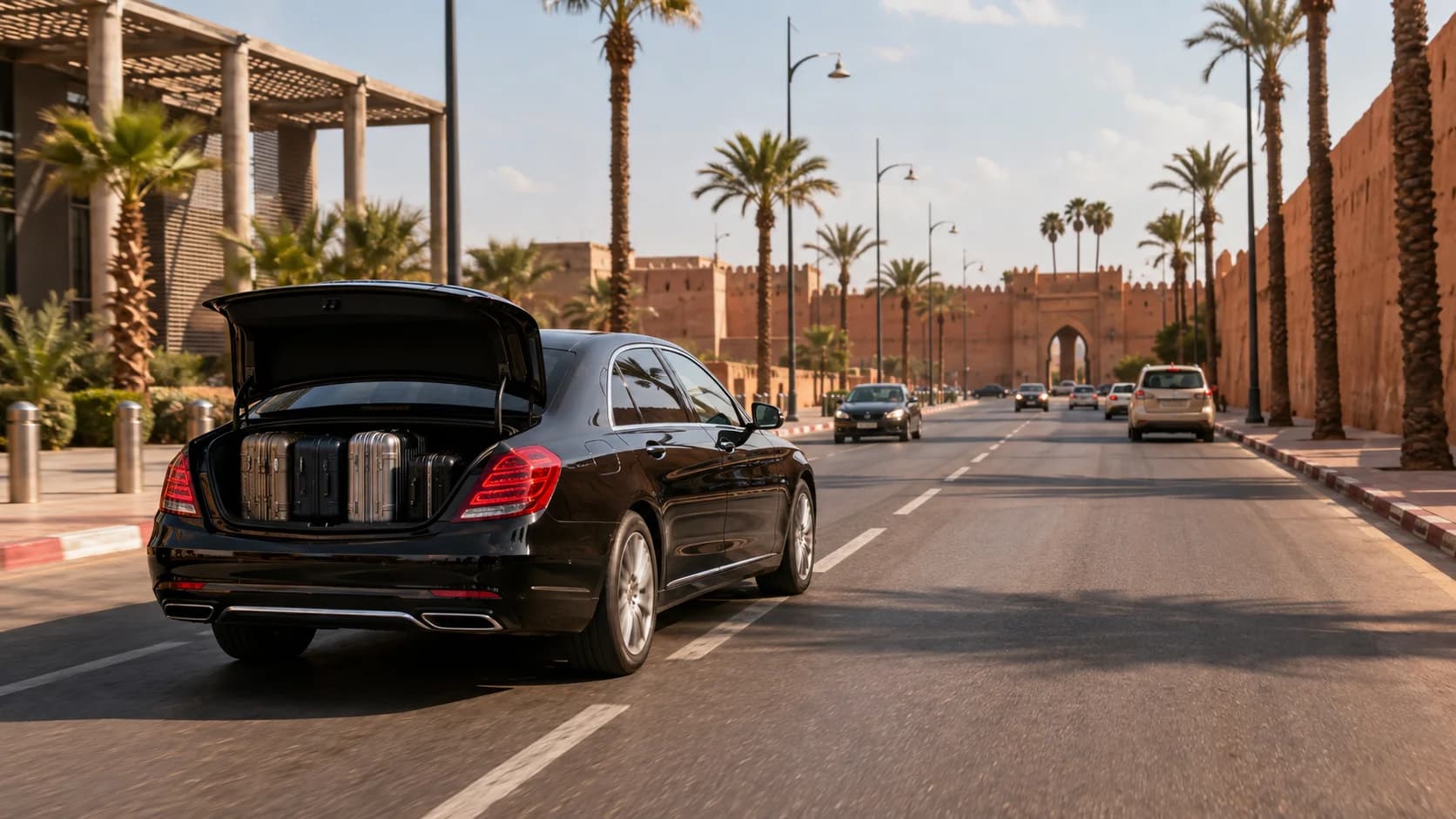









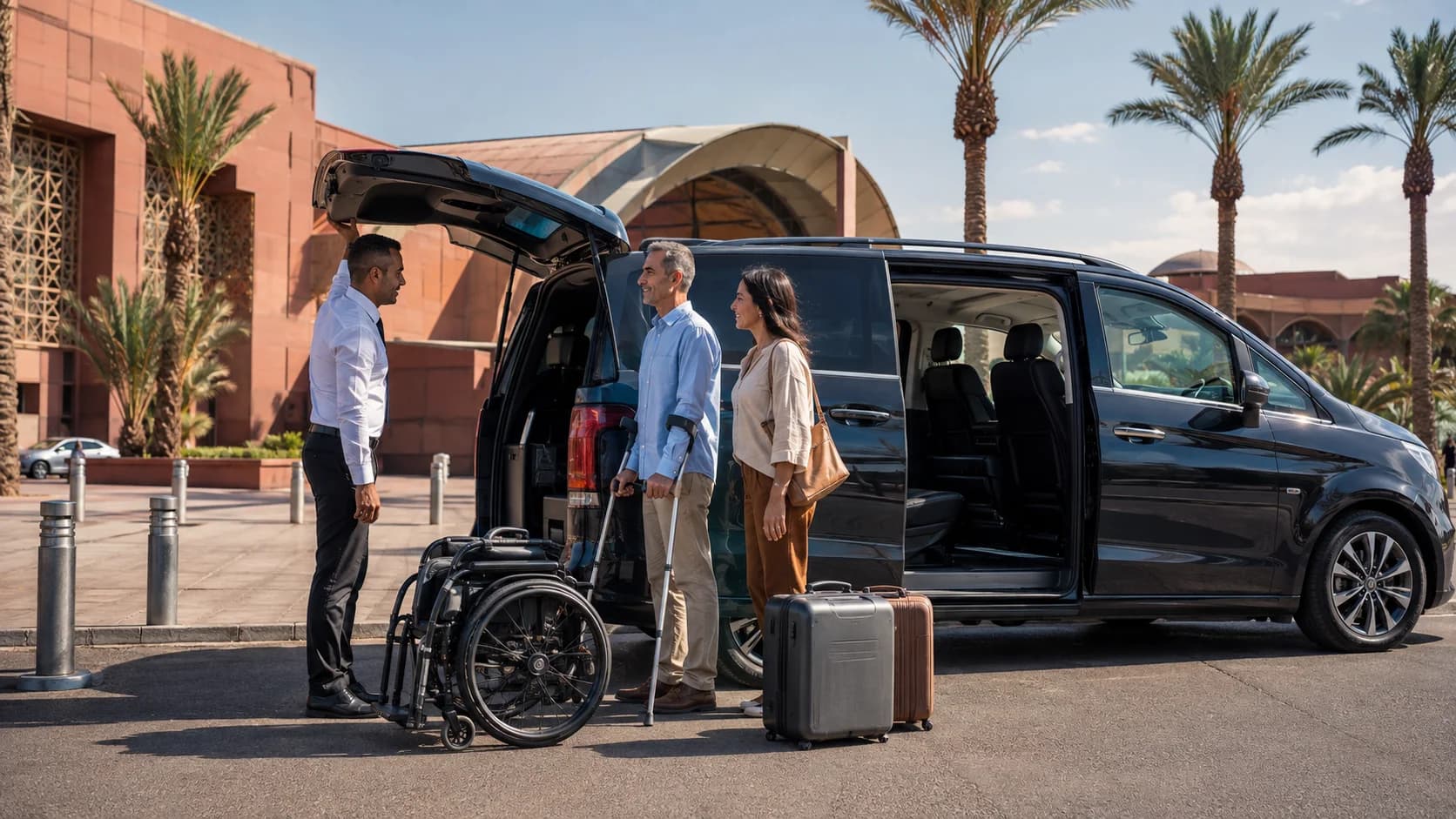
Arranging a wheelchair accessible transfer Marrakech travellers can rely on requires more than selecting a vehicle category and providing a flight number. The booking team must understand the passenger’s mobility, the type and dimensions of the wheelchair, whether the passenger can transfer into a standard vehicle seat, and how many companions and bags will be travelling.
A minivan may provide more room than a sedan, but that does not automatically make it wheelchair accessible. Likewise, a vehicle with a large boot may accommodate a folding manual wheelchair but may not be suitable for a powered wheelchair or for a passenger who needs to remain seated in the wheelchair.
The safest approach is advance validation. Share the complete requirements before booking and request written confirmation of the vehicle arrangement.
Table of Contents
- Planning an accessible transfer
- What to explain before booking
- Can the passenger transfer into a standard seat?
- Wheelchair dimensions and folding requirements
- Choosing the most suitable vehicle
- Airport pickup and mobility assistance
- Medina and riad accessibility limits
- Travelling with companions and luggage
- Why vehicle suitability must be confirmed
- Accessible-transfer booking checklist
- Frequently asked questions
Planning an Accessible Transfer
To arrange a Marrakech Airport transfer for a wheelchair user or traveller with reduced mobility, contact the transfer provider before arrival and explain:
-
Whether the passenger can enter a standard vehicle seat
-
Whether the wheelchair is manual or powered
-
Whether it folds or separates into smaller parts
-
Its folded and unfolded dimensions
-
Its approximate weight
-
The number of companions
-
The number and size of bags
-
Whether additional mobility equipment is travelling
-
Whether the accommodation is reachable by vehicle
-
What assistance is expected from the driver
Do not assume that “minivan,” “large vehicle” or “wheelchair transfer” means the vehicle has a ramp, lift, lowered floor or wheelchair restraint system. These features must be specifically requested and confirmed.
Airport assistance and the private road transfer should also be arranged separately. Passengers who require help moving through the terminal should request special assistance through their airline or travel organiser before the flight. Royal Air Maroc, for example, provides a dedicated process for requesting assistance for passengers with reduced mobility, wheelchair users and other passengers requiring support.
What to Explain Before Booking
Accessibility requirements vary considerably between passengers. A booking message that says only “one passenger uses a wheelchair” does not provide enough information to select a suitable vehicle.
The transfer provider needs to understand how the journey will work from the terminal exit to the final destination.
Explain whether the passenger can:
-
Walk a short distance with support
-
Stand briefly while entering the vehicle
-
Use a normal passenger seat
-
Manage one or more steps
-
Bend sufficiently to enter a low car
-
Move independently between the wheelchair and vehicle
-
Transfer only with help from a companion
-
Remain seated upright for the journey
You should also describe the assistance that will already be provided by family members, personal assistants or airport staff.
A driver may be able to offer reasonable help with doors and luggage, but this should not be confused with trained medical assistance, manual lifting or personal care. Any request involving physical lifting, specialist transfer techniques or medical support must be discussed clearly before booking.
Advance validation rather than assumptions
The objective is not simply to reserve the largest available car. It is to establish whether the passenger, wheelchair, companions and luggage can all be transported safely and comfortably.
A useful request might say:
One passenger uses a folding manual wheelchair. The passenger can transfer into a normal vehicle seat with help from a companion. The folded chair measures approximately 85 × 30 × 75 centimetres and weighs 14 kilograms. Three people will travel with two medium suitcases.
This information gives the provider a much stronger basis for checking a sedan, SUV or minivan than a general request for an “accessible taxi.”
Can the Passenger Transfer Into a Standard Seat?
This is usually the most important question when arranging an accessible private transfer Marrakech visitors can use.
There are two different transport situations.
The passenger can transfer into a vehicle seat
When the passenger can leave the wheelchair and sit in a standard seat, the wheelchair may be stored in the boot or luggage area. Vehicle selection then depends on:
-
Ease of entry
-
Seat height
-
Door opening
-
Legroom
-
Wheelchair dimensions
-
Boot capacity
-
Companion and luggage requirements
A higher vehicle may be easier for some passengers to enter, but it may be too high for others. A low sedan can create a different difficulty because the passenger must lower themselves further into the seat.
Individual transfer ability matters more than choosing a vehicle based only on its category.
The passenger must remain in the wheelchair
A passenger who needs to remain seated in the wheelchair during the journey generally requires a specially adapted vehicle. That normally means the exact vehicle must have appropriate boarding equipment, sufficient internal height and space, and a suitable wheelchair and occupant restraint arrangement.
A standard sedan or ordinary passenger minivan should not be presented as suitable for this purpose without explicit verification.
When requesting a vehicle for an occupied wheelchair, ask direct questions:
-
Does the exact vehicle have a ramp or powered lift?
-
Is the wheelchair secured to the vehicle?
-
Is there an occupant restraint system?
-
What are the entrance width and internal height?
-
What wheelchair dimensions and weight can be accepted?
-
Is advance reservation mandatory?
-
Can photographs or specifications of the exact setup be provided?
Do not complete the booking until these points have been answered clearly.
Wheelchair Dimensions and Folding Requirements
Wheelchair size is essential because two chairs described as “folding wheelchairs” may occupy very different amounts of space.
Provide measurements in centimetres, including:
-
Overall width
-
Overall height
-
Overall length
-
Folded width
-
Folded height
-
Folded length
-
Approximate total weight
Mention whether any parts can be removed, such as:
-
Footrests
-
Headrests
-
Seat cushions
-
Wheels
-
Batteries
-
Joystick controls
-
Support attachments
Manual wheelchairs
A compact folding manual wheelchair may fit in the boot of some sedans, particularly when the passenger has limited luggage. However, boot shape, opening width and depth vary between vehicle models.
The provider should therefore confirm the actual vehicle rather than promising that every sedan can carry the chair.
Rigid-frame wheelchairs
Rigid-frame chairs may be lightweight but take up more space because the main frame does not fold. Even when the wheels are removable, the chair may require a larger boot or a minivan luggage area.
Send photographs and complete dimensions when requesting the transfer.
Powered wheelchairs
Powered wheelchairs are usually heavier and may have batteries, motors and delicate electronic controls. A normal passenger vehicle may not have the loading equipment or luggage capacity required.
Explain:
-
Total chair weight
-
Battery type
-
Whether the battery is removable
-
Whether the chair can be dismantled
-
Whether it can be safely lifted
-
Whether the passenger can use another seat
-
Whether the chair must remain upright
The transfer operator should confirm how the equipment will be loaded, carried and protected. Never assume that a large boot alone makes a vehicle suitable for a powered wheelchair.
Choosing the Most Suitable Vehicle
The most suitable vehicle depends on the complete travel arrangement rather than the wheelchair alone.
Sedan transfer
A private sedan can be considered when:
-
The passenger can use a standard seat
-
The wheelchair folds compactly
-
The chair is not excessively heavy
-
The group is small
-
Luggage is limited
-
The passenger can manage the vehicle’s entry height
Travellers can review a private sedan driver in Marrakech, but the exact wheelchair and luggage capacity must still be confirmed before booking.
Minivan transfer
A minivan transfer in Marrakech may be more practical for a family, a group with several bags or a passenger travelling with bulky mobility equipment.
Possible advantages include more luggage room, wider access and a more flexible seating layout. However, a standard minivan is not automatically equipped with:
-
A wheelchair ramp
-
A powered lift
-
An occupied-wheelchair position
-
Wheelchair floor restraints
-
Specialist passenger restraints
-
A lowered floor
Ask what equipment the exact vehicle has instead of relying on the category name.
Matching the vehicle to the full group
Imagine that four adults are travelling with a folding wheelchair, four large suitcases and two cabin bags. A vehicle may technically have enough passenger seats but insufficient luggage space once the chair has been loaded.
Provide the entire group configuration so the booking team can check:
-
Passenger seats required
-
Seats that may need to be folded
-
Wheelchair storage position
-
Suitcase capacity
-
Safe access to the passenger
-
Space for walking aids or medical equipment
In some situations, two vehicles may be more appropriate than placing passengers and equipment into an overcrowded vehicle.
Airport Pickup and Mobility Assistance
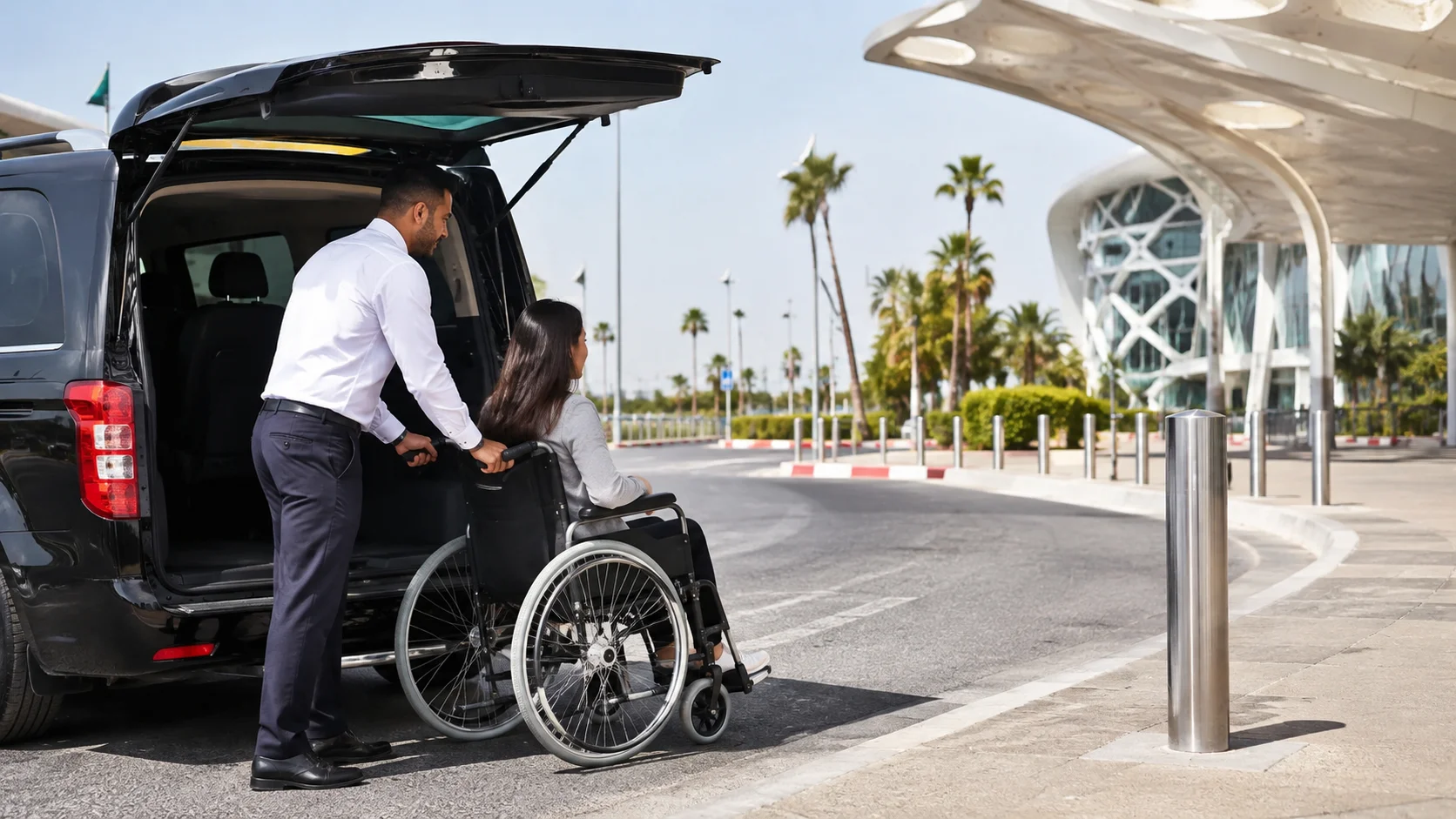
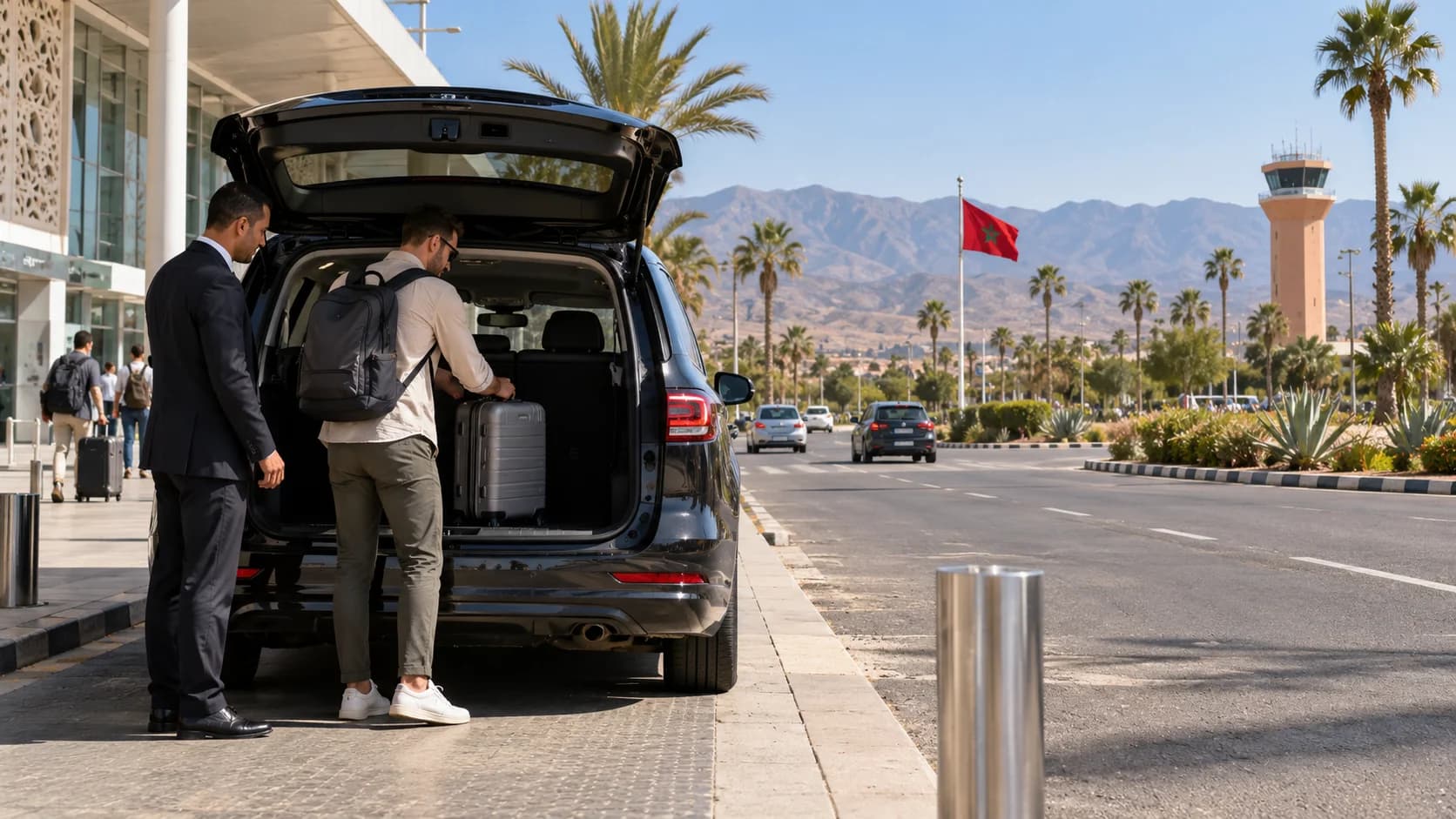
A private Marrakech airport transfer normally begins at a confirmed meeting point after the passenger has completed immigration and collected their baggage.
The transfer operator should receive:
-
Flight number
-
Scheduled arrival time
-
Passenger name
-
Working mobile or WhatsApp number
-
Assistance requirements
-
Expected terminal-exit arrangement
-
Contact details for a companion when applicable
Airport assistance is a separate service
The private driver usually meets passengers after they reach the public arrivals area. Assistance between the aircraft, immigration, baggage reclaim and terminal exit generally needs to be coordinated through the airline or relevant airport service.
Travellers requiring wheelchair support inside the airport should contact their airline as early as possible and confirm where the assistance will end. Airline procedures may require advance notice and details about the passenger’s mobility or wheelchair.
Do not assume that the private driver can enter restricted airport areas or collect the passenger directly from the aircraft.
Confirming the meeting point
Before travelling, ask for written instructions covering:
-
Where the driver will wait
-
How the passenger or companion will identify the driver
-
Which phone number to call
-
What happens if airport assistance takes longer than expected
-
Whether waiting time has been considered
-
Where the vehicle will be positioned
-
How far the passenger must move from the terminal exit
This coordination is particularly important when the passenger cannot stand for long periods or move extended distances.
Medina and Riad Accessibility Limits
A successful airport pickup does not guarantee that the vehicle can reach the entrance of the accommodation.
Parts of Marrakech’s medina contain narrow lanes, pedestrian areas, uneven surfaces, steps and streets where normal vehicles cannot enter. Some riads are located several minutes from the nearest accessible drop-off point.
Before booking, ask the accommodation:
-
Can a car stop directly at the entrance?
-
What is the nearest vehicle-accessible location?
-
How far is it from the drop-off point?
-
Is the route level, paved and wide enough?
-
Are there steps, steep slopes or uneven surfaces?
-
Can accommodation staff meet the passenger?
-
Is luggage assistance available?
-
Is there an accessible entrance?
-
Does the building have a lift?
-
Is the booked room reachable without stairs?
Avoid relying only on a map pin. A property may appear beside a road online while its actual entrance is inside a vehicle-restricted lane.
Planning the final access
Send the accommodation name, full address and map location to the transfer provider in advance. When possible, ask the accommodation and driver to agree on the most suitable meeting or drop-off point.
For travellers with substantial mobility limitations, selecting a hotel or residence with confirmed vehicle access may simplify the entire journey.
Travelling With Companions and Luggage
Companions often provide essential support during transfers, so each person must be included in the vehicle plan.
State whether the passenger travels with:
-
A family member
-
A personal assistant
-
A carer
-
Children
-
A larger family or tour group
Then list all equipment and luggage, including:
-
Checked suitcases
-
Cabin bags
-
Wheelchair
-
Walking frame
-
Crutches
-
Portable hoist
-
Shower chair
-
Oxygen equipment
-
Medical bags
-
Seat cushions
-
Child seats
A seven-seat vehicle does not necessarily have luggage space for seven passengers, a wheelchair and multiple suitcases. In many vehicles, using every passenger seat considerably reduces storage capacity.
The safest booking is based on usable space, not the advertised maximum seat count.
Why Vehicle Suitability Must Be Confirmed
Vehicle fleets can change because of maintenance, scheduling or availability. Even two vehicles in the same category may have different door openings, seat heights and boot layouts.
That is why accessibility requirements should be included in the booking record and confirmed in writing.
The confirmation should state:
-
Whether the passenger transfers into a standard seat
-
Whether the wheelchair will be accepted
-
Whether it must fold
-
The measurements supplied
-
The number of travellers
-
The luggage quantity
-
The selected vehicle type
-
Whether specialist boarding equipment is available
-
The agreed airport meeting point
-
The final vehicle-accessible drop-off point
-
Any assistance limitations
When a particular adapted feature is essential, request confirmation of the exact vehicle rather than a general promise that a similar vehicle will be arranged.
This protects the traveller from arriving at Marrakech Airport and discovering that the chair cannot be loaded or that the passenger cannot safely enter the vehicle.
Accessible-Transfer Booking Checklist
Use this checklist when requesting a transfer:
Passenger information
-
Passenger can or cannot transfer into a normal seat
-
Passenger can or cannot walk a short distance
-
Assistance required during entry and exit
-
Preferred seating position
-
Relevant access limitations clearly explained
Wheelchair information
-
Manual, rigid-frame or powered
-
Folding or non-folding
-
Folded and unfolded dimensions
-
Total weight
-
Removable components
-
Battery information where relevant
-
Photograph supplied
Journey information
-
Flight number and arrival time
-
Airport-assistance request made separately
-
Terminal meeting point confirmed
-
Driver contact details received
-
Accommodation access checked
-
Nearest vehicle drop-off point confirmed
Group information
-
Total passenger count
-
Number of companions
-
Number and size of bags
-
Additional mobility aids
-
Medical or support equipment
-
Child-seat requirements
Vehicle confirmation
-
Exact vehicle category confirmed
-
Entry and storage suitability checked
-
Ramp or lift confirmed when essential
-
Wheelchair restraint arrangement confirmed when essential
-
No unsupported accessibility assumptions
-
Requirements recorded in writing
Plan With Clarity Before Arrival
A reliable transfer for a wheelchair user or traveller with reduced mobility begins with complete information. The best vehicle cannot be selected from the passenger count alone.
Share the passenger’s transfer ability, the wheelchair type and measurements, the number of companions, the luggage quantity and the accommodation access details. Then ask the provider to check the arrangement and confirm what can genuinely be supplied.
This advance preparation creates a clearer and safer arrival plan while avoiding unsupported promises about vehicle accessibility.
Frequently Asked Questions
Can I book a wheelchair-accessible transfer in Marrakech?
You can request a transfer for a wheelchair user, but suitability depends on the passenger’s needs and the equipment available. Explain whether the passenger can use a standard seat and whether the wheelchair folds. Any need for a ramp, lift or occupied-wheelchair position must be specifically verified.
Do your vehicles have wheelchair ramps or lifts?
Do not assume that a standard sedan, SUV or minivan has a ramp or lift. These are specialist features and must be requested before booking. The provider should confirm the equipment available on the exact vehicle.
Can a folding wheelchair fit in a sedan?
Some compact manual folding wheelchairs may fit in certain sedan boots, especially when luggage is limited. Compatibility depends on the folded dimensions, weight, boot opening and number of bags. Send measurements and request confirmation.
What wheelchair measurements should I provide?
Provide the width, height and length when unfolded and folded, together with the total weight. Explain whether the wheels, footrests, battery, headrest or other parts can be removed.
Can the passenger remain seated in the wheelchair during the ride?
Only when an appropriately adapted vehicle has been confirmed. The vehicle must have suitable access, internal space and wheelchair and occupant restraint arrangements. A normal passenger minivan should not be assumed to offer this setup.
Which vehicle is best for reduced-mobility travellers?
The best vehicle depends on the passenger’s transfer ability, preferred seat height, wheelchair size, companion count and luggage. A sedan may work for a compact folding chair, while a minivan may provide more room. Neither is automatically suitable for every passenger.
Can the driver assist at Marrakech Airport?
The driver may be able to help with doors and luggage at the agreed public meeting point, but airport-terminal assistance should be requested separately through the airline or relevant airport service. Clarify exactly what help is expected from the driver before booking.
Are all Marrakech riads accessible by vehicle?
No. Some riads are in narrow or pedestrianised medina streets that ordinary vehicles cannot reach. Confirm the nearest vehicle-accessible drop-off point and ask about the surface, distance, steps and assistance between that point and the entrance.
Can companions and luggage travel in the same vehicle?
Often they can, but the full arrangement must be checked. Passenger seats, the wheelchair and suitcases all compete for available space. Provide exact passenger and luggage numbers before selecting the vehicle.
Why must accessibility requirements be confirmed before booking?
Wheelchairs and mobility needs differ, and vehicles in the same category can have different entrances and storage layouts. Written confirmation reduces the risk of an unsuitable vehicle arriving at the airport.